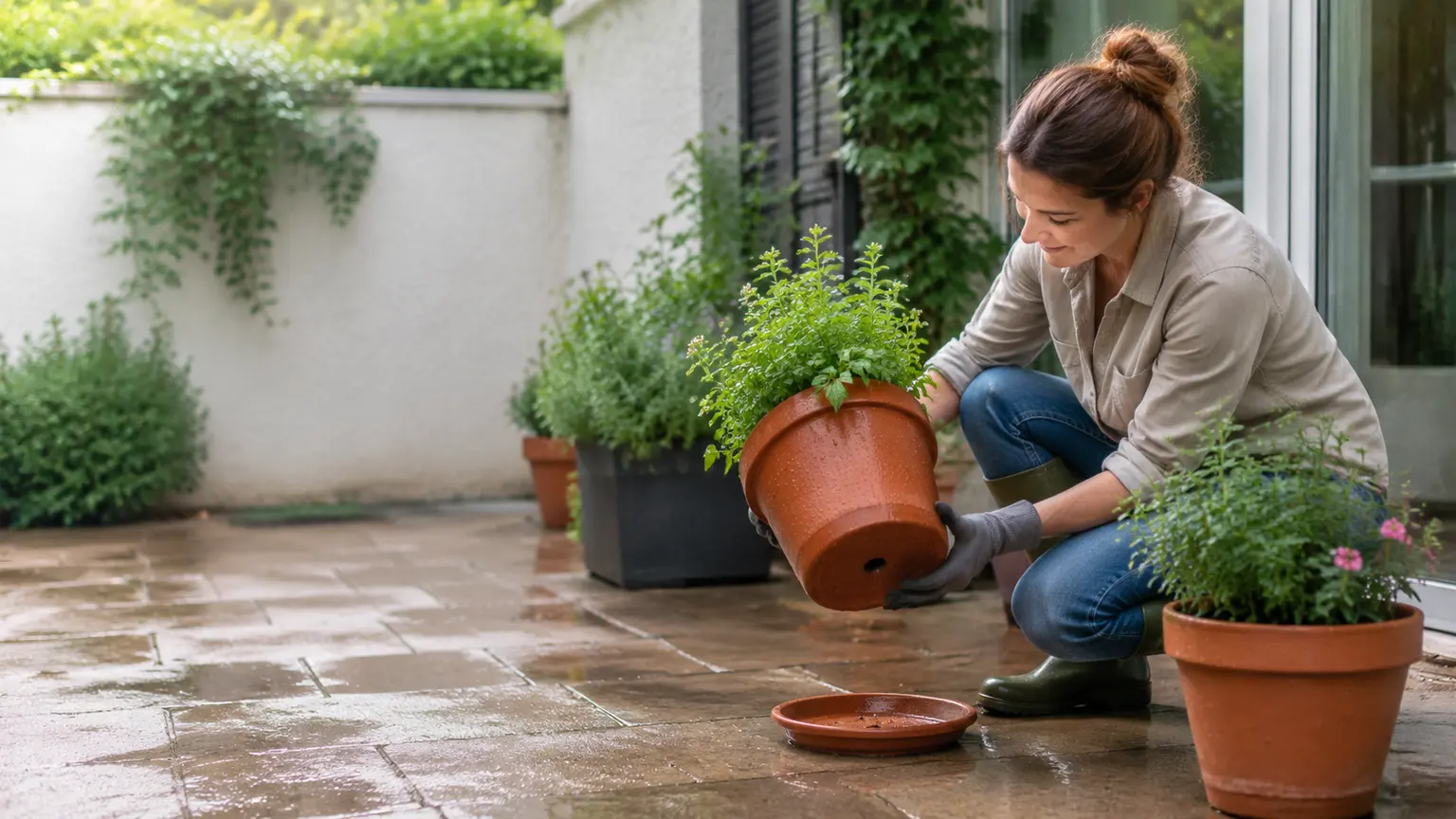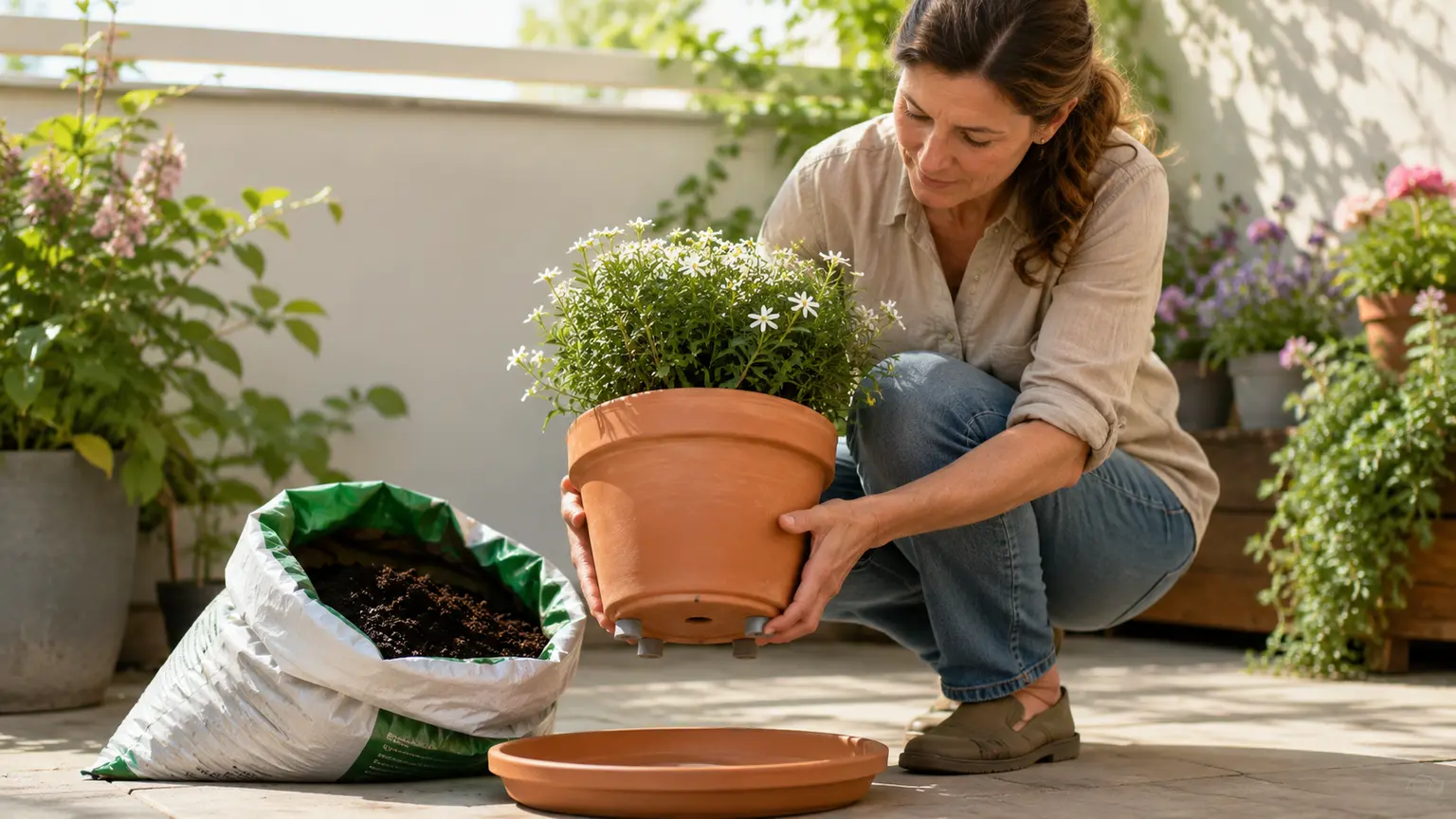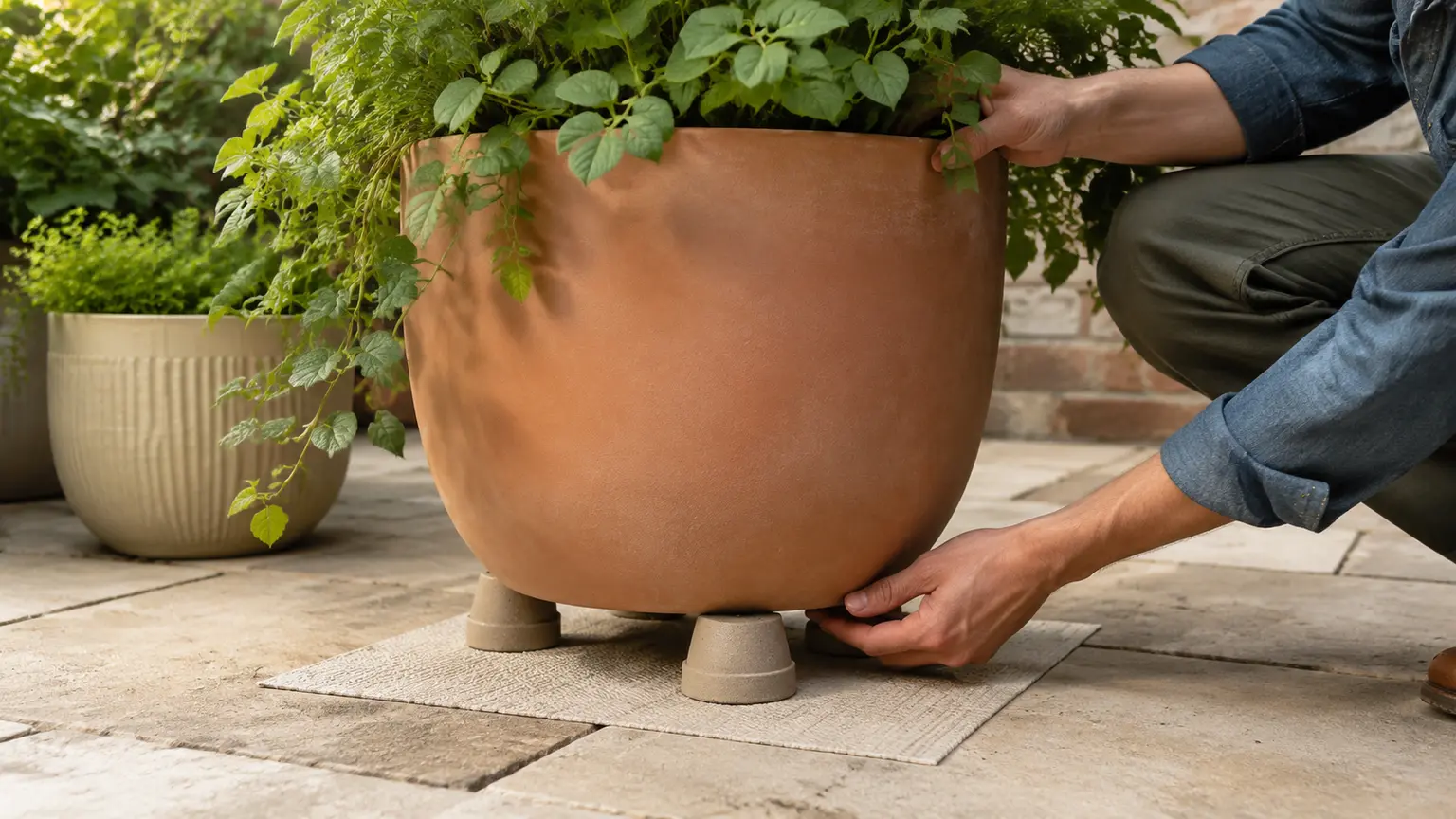
A planter that sits flat against a patio can press its drainage holes against the surface. Water may then have trouble leaving the container, and moisture or residue can remain beneath the pot. A modest lift with purpose-made, outdoor-rated pot feet or risers can create space for water to exit and may help reduce surface marking.
The right setup depends on the planter’s loaded weight, base shape, exposure to wind, support design, and patio material. There is no universal riser height, number of feet, spacing pattern, or load rating that suits every container. Treat the project as a fit, stability, and surface-care task—not as a one-size-fits-all drainage fix.
How high should a planter be raised for drainage?
Elevation works outside the container. It can keep existing drainage openings from being sealed against the patio and provide a visible route for water beneath the planter. Extension guidance from North Carolina State University and the University of Wisconsin–Milwaukee supports using pot feet or similar elevation to facilitate drainage and help reduce patio marking.
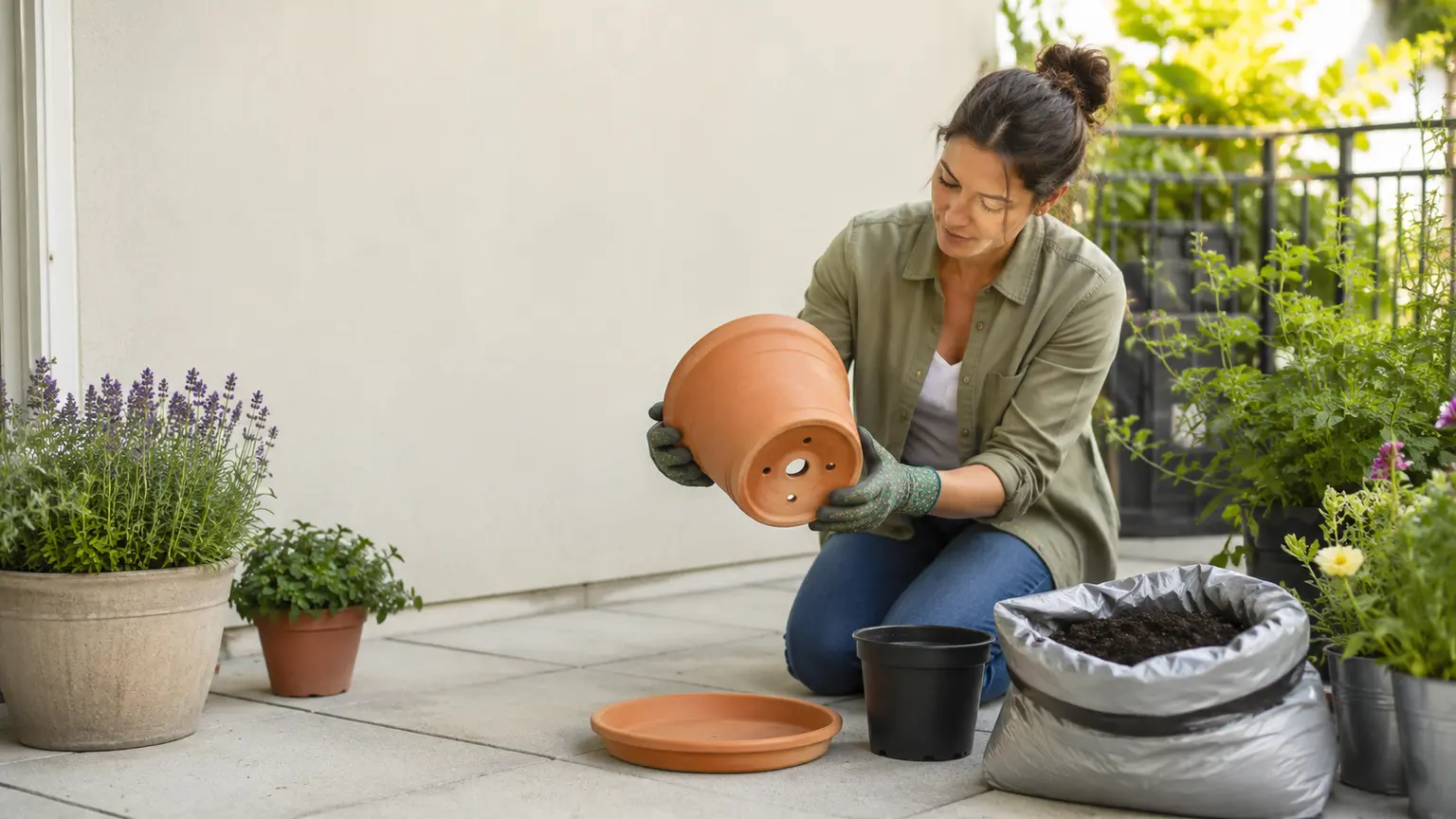
Before buying supports, check the patio pot for drainage problems while it is still empty. It should have open, functioning drainage holes. Raising a container cannot replace holes or correct a planter that holds water because its openings are blocked or its design drains poorly. Choose a container with existing holes; if a decorative outer pot is involved, use a removable inner nursery pot with holes and empty water that collects in the outer container as needed.
| What you see | What it usually means | First response |
|---|---|---|
| A drainage hole touches the patio | The outlet can be sealed or obstructed | Reposition the supports so the hole remains visibly clear |
| The pot rocks after watering | The load is uneven or the base does not fit the supports | Stop and choose a lower, wider, or better-matched support |
| Runoff stays beneath the pot | The patio has a low spot or the exit route is blocked | Clear debris or move the planter to a safe drainage path |
| A saucer remains full | Water has left the pot but not the setup | Empty and manage the saucer after rain |
Choose feet or risers that fit the planter and patio
Select purpose-made supports intended for outdoor use, then compare their directions with the actual planter you plan to lift. Outdoor exposure, wet soil, and repeated watering can be demanding. Iowa State University Extension advises checking whether outdoor containers are labeled for outdoor use or UV protection; as a practical extension of that guidance, consult the riser maker’s outdoor-use and load information as well.
Assess the planter when it is fully loaded, not when it is empty. Wet growing medium, the container itself, and a mature plant can make a substantial difference. A tall plant can also shift the center of weight, particularly where wind reaches the patio or balcony. Rutgers recommends a wide-based container for a tall plant, and Colorado State University Extension notes that a heavier container can help reduce tipping from imbalance or wind.
- Measure or closely assess the planter’s full base. Supports need to sit beneath a flat, structurally sound area rather than partly under a curved edge.
- Check the planter’s wet weight against the support maker’s stated information. If the maker does not provide enough information for your setup, choose a different support or ask the maker for clarification.
- Look for a configuration that bears evenly and leaves the drainage openings clear. Do not assume that more supports, a taller support, or a particular spacing pattern is automatically safer.
- Consider tipping risk from plant height, wind, foot traffic, and the planter’s shape. A narrow or top-heavy container may need a different location or container choice, not simply a taller lift.
- Check the patio, balcony, or decking care guidance before placing any support. Material compatibility is specific to the surface finish and the support product. Where practical, test a discreet area first.
Favor stable, non-improvised supports. Avoid cracked, loose, uneven, or stackable objects. Bricks and wheeled caddies appear in general extension guidance as examples of elevation, but that does not make every brick, caddy, or patio combination suitable. This guide’s scope is purpose-made, outdoor-rated feet or risers used according to their placement and load directions.
Set the planter down for stability and a clear escape route for water
Begin with a firm, reasonably level, sound surface. Remove grit and loose debris from the area, then position the supports so they bear evenly beneath the planter’s stable base. Each support should remain fully under the area it is intended to carry, with no rocking or partial contact.
Keep every drainage opening clear. If the planter has several openings, look beneath the base to confirm that none is pressed against a support or blocked by debris. The goal is not merely to create a gap; it is to maintain a continuous path from the hole to the patio surface.
- Set the empty or manageable planter on the supports and check for rocking.
- Confirm that the supports sit flat and evenly beneath the planter’s base.
- Add the planting medium and plant only if the loaded setup remains stable and within the support maker’s guidance.
- Water slowly enough to observe the drainage path. Check that water exits each opening and does not pool beneath the planter.
- Watch where the water travels. Do not direct runoff toward a door, foundation, shared balcony area, electrical equipment, neighboring property, or walking path.
- Recheck the setup after it has been watered and after rain, since the added weight and wet conditions can change how it sits.
If water remains trapped inside an outer container, empty it rather than allowing the inner pot to stand in accumulated water. Colorado State University Extension and University of Illinois Extension both emphasize maintaining drainage space around an insert and keeping the liner from standing in collected water.
Protect the surface through observation, not promises
Pot feet can help reduce staining or moisture marks, but they cannot guarantee that a patio will remain unmarked. Results vary with the patio material and finish, existing residue, water quality, pot material, weather, and how long moisture remains in contact with the surface. Supports can also trap grit or moisture, shift, scratch, or discolor some finishes.
Follow the patio, deck, or balcony manufacturer’s care guidance where available. For a surface with a specialized finish, check compatibility with the support maker as well. A discreet test area can reveal problems before the planter is positioned in a prominent or difficult-to-reach location.
A simple maintenance routine
- Inspect beneath the planter after watering and after heavy rain. Look for pooling, residue, or a blocked drainage path.
- Clear leaves, soil, and grit from the base and around the supports.
- Check for shifting, cracking, rocking, or a support that no longer bears evenly.
- Move or lift the planter carefully at intervals appropriate for its size so you can clean and inspect the patio surface. Get help with a heavy container rather than dragging it.
- Review the drainage route if the planter is moved, the plant becomes taller, or the patio arrangement changes.
For balconies, leased properties, shared spaces, or locations where runoff could affect other people, check applicable building, lease, association, or site requirements. Balcony load and drainage conditions are site-specific and are not addressed by a general riser choice.
The practical takeaway
A stable, outdoor-rated riser is a small exterior adjustment that can help a patio planter drain freely and reduce prolonged contact between the pot and surface. Start with a planter that already has open drainage holes. Match the supports to the planter’s loaded weight and base, place everything on a firm surface, keep the exit path visible, and observe where water goes. Regular checks are more reliable than promises about a particular material, height, or product working everywhere.
Sources and further reading
- repository.lib.ncsu.edu — repository.lib.ncsu.edu
- extension.illinois.edu — extension.illinois.edu
- milwaukee.extension.wisc.edu — milwaukee.extension.wisc.edu
- njaes.rutgers.edu — njaes.rutgers.edu
- yardandgarden.extension.iastate.edu — yardandgarden.extension.iastate.edu
- extension.colostate.edu — extension.colostate.edu