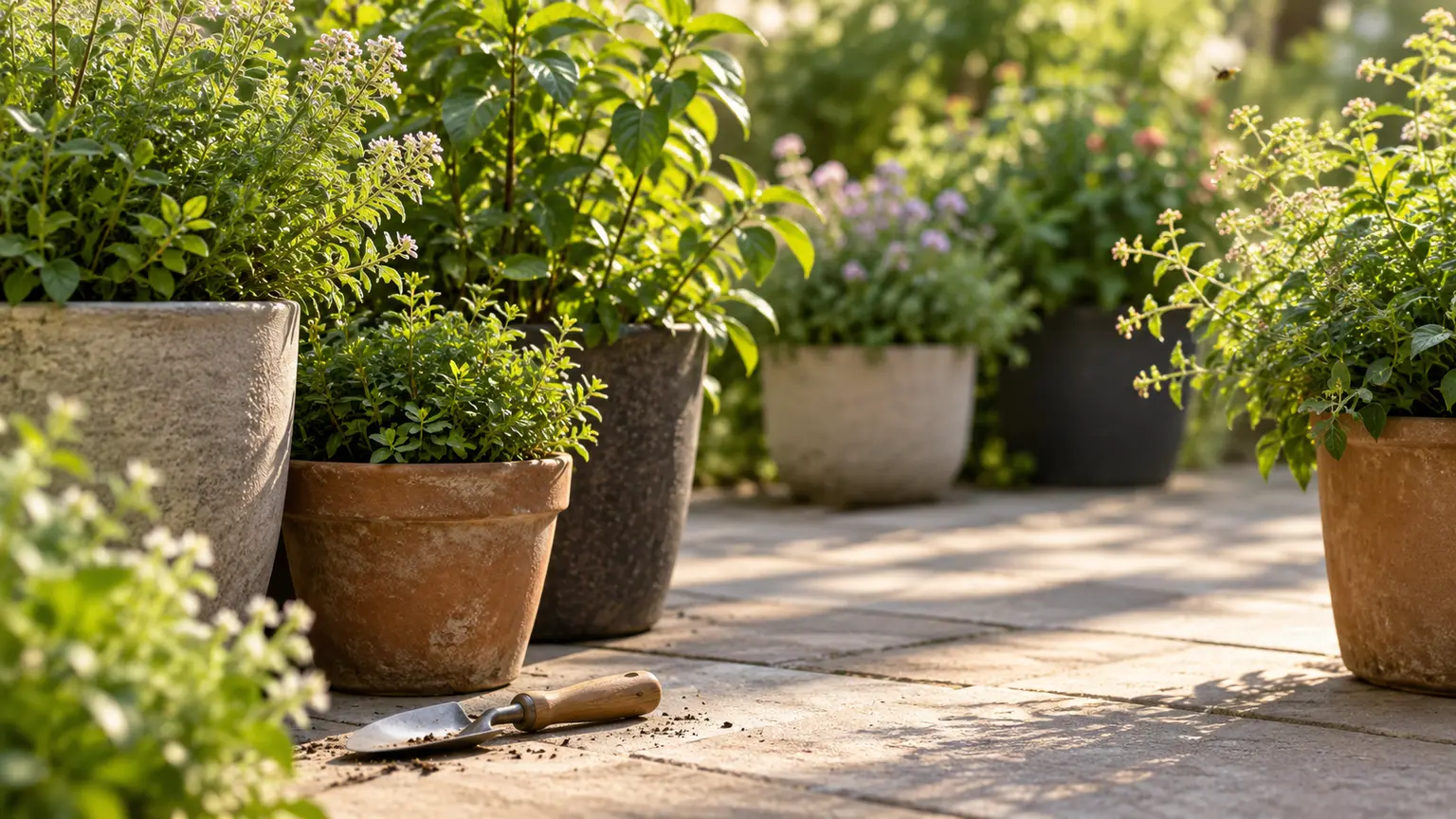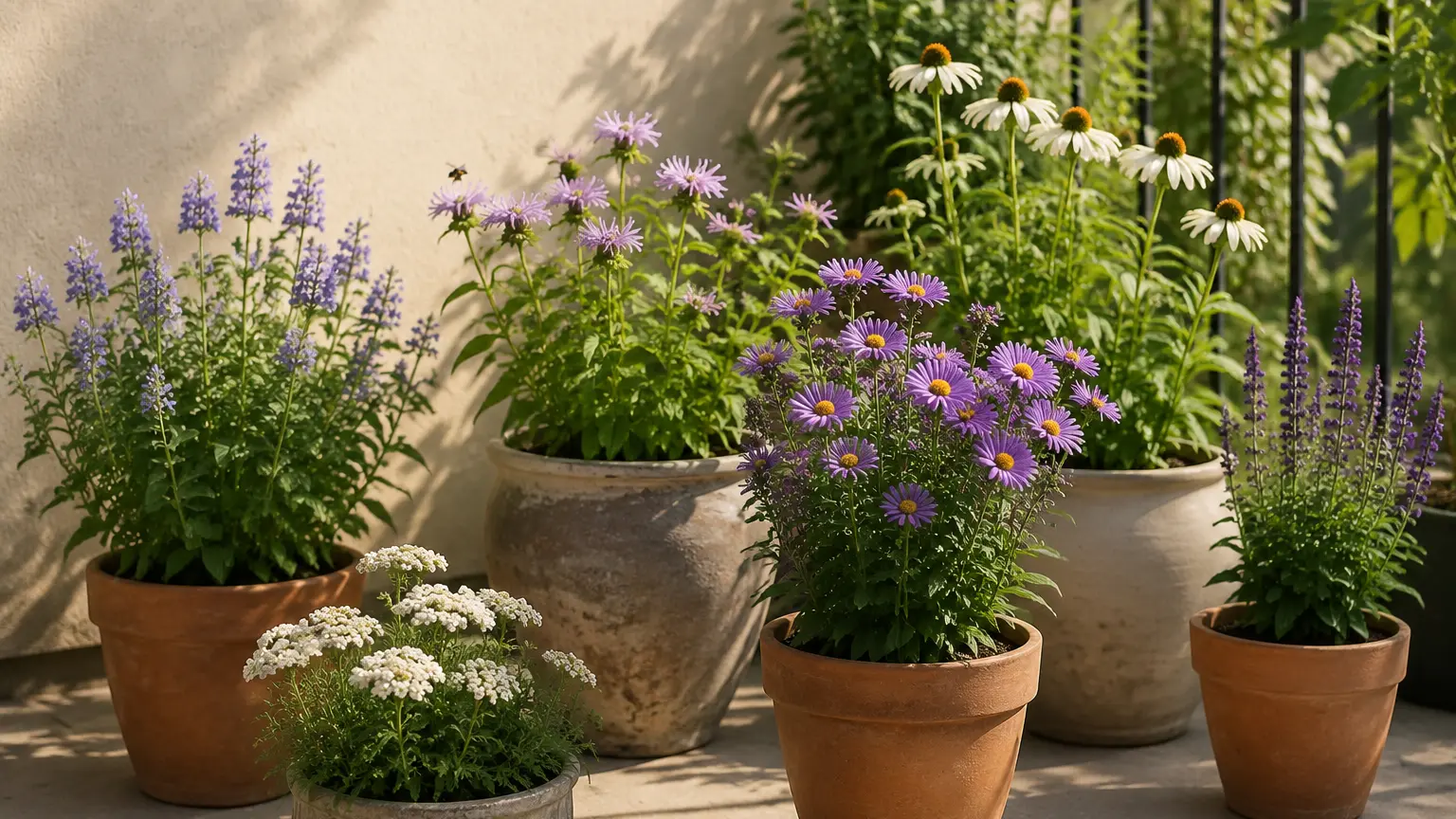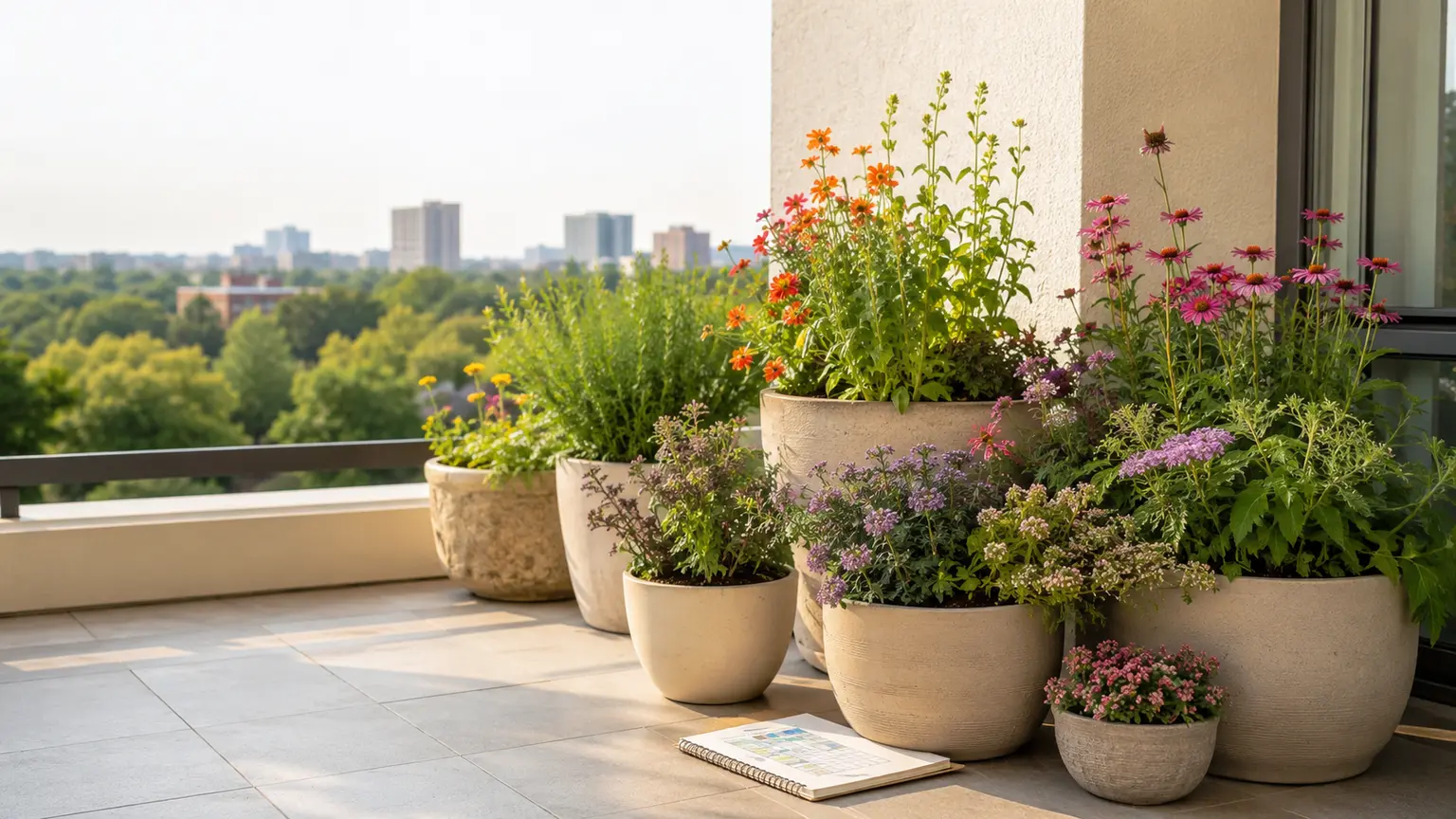
A balcony can provide useful floral resources in a surprisingly small footprint. It can also be hot, windy, exposed, and difficult to water consistently. The most reliable plan starts with the space itself—not with a national list of “best” pollinator plants.
Use the microclimate map from guide 1 as your first filter. Record the hours of direct sun, reflected heat from walls or pavement, wind exposure, available pot volume, drainage, access to water, and winter exposure. Then use regional native-plant resources to build a short list, organize candidates by early-, middle-, and late-season bloom windows, and match each plant’s needs to a suitable container.
Start with the balcony you actually have
Before choosing flowers, inspect the conditions at the intended growing location. A plant that performs well in the ground may not tolerate a small, hot, windy pot without regular irrigation. Container media can dry more quickly than in-ground soil, and plants sharing one container need compatible light, moisture, drainage, and soil requirements.
- Track direct sun at different times of day, rather than relying only on the balcony’s general direction.
- Note reflected heat from masonry, glass, metal, or nearby pavement. This can make a container warmer and drier than the surrounding neighborhood.
- Identify wind exposure, especially at corners, railings, and higher floors. Wind can increase drying and stress stems.
- Measure the usable pot area and choose containers based on mature plant dimensions, not just the size of a nursery plant.
- Check that containers have appropriate drainage and that watering is practical without creating problems below the balcony.
- Record winter exposure. Cold, wind, and the limited insulation of a container can differ from conditions at ground level.
Eliminate candidates that fail the site conditions before considering their pollinator value. If only one part of the balcony receives suitable light, concentrate the best-matched plants there instead of trying to make every corner serve the same purpose.
Build a local candidate list, not a national wish list
“Native” is a regional question. A plant native to one part of the United States may not be native to another, and a plant recommended for a landscape bed may be a poor choice for a small container. Start with the National Park Service ecoregional planting guide cards or the regional resources at Pollinator.org. These tools can help identify native flowers associated with your state or multistate region and can suggest plants that cover the local growing season.
Treat those resources as a starting point, not a finished shopping list. For each candidate, verify local nativity, mature size, bloom window, light and moisture needs, and whether it is reasonably suited to a container. A state Extension office, native-plant society, or conservation district can help resolve questions about local timing and provenance.
- Choose a regional lookup tool and save more candidates than you expect to use.
- Remove plants whose mature dimensions exceed the available pot or would quickly overwhelm their neighbors.
- Separate candidates by light and moisture needs before designing mixed containers.
- Ask whether each plant is primarily useful for nectar and pollen, larval host value, or both.
- Check local sources for any plant that is nonnative, regulated, or potentially invasive before buying it.
- Confirm the expected bloom sequence for your locality rather than assigning fixed national dates.
Simple containers are often easier to manage than crowded combinations. Differences in height and growth habit can add interest, but only after cultural needs match. Separate pots may be the better design when plants need different watering, have different mature sizes, or will be replaced at different times.
Make a season-long menu: bloom windows plus host value
Plan for overlap rather than one dramatic flowering peak. University of Georgia Extension recommends mixing bloom times in container pollinator gardens so nectar and pollen are available over a longer portion of the season. Because bloom periods vary with region, elevation, weather, planting date, cultivar, and balcony heat exposure, use seasonal windows instead of fixed calendar months.
| Seasonal window | Candidate plant | Nectar and/or pollen value | Larval-host value | Container and care notes |
|---|---|---|---|---|
| Early season | Add a locally native, container-suitable candidate | Record which floral resources it provides | Record a verified host association, or write “not selected” | Note light, pot volume, moisture, and mature size |
| Middle season | Add a locally native, container-suitable candidate | Record which floral resources it provides | Record a verified host association, or write “not selected” | Note compatibility with neighboring plants |
| Late season | Add a locally native, container-suitable candidate | Record which floral resources it provides | Record a verified host association, or write “not selected” | Note heat, drying, and winter implications |
For every seasonal slot, prioritize a locally appropriate plant that offers nectar and/or pollen. Where conditions and space allow, add a locally suitable larval host plant as a separate function. Nectar and pollen plants support adult foraging, while host plants can support caterpillar development; they are not interchangeable planning categories. Verify the host association by species and region rather than assuming that a plant supports every butterfly or moth.
A host plant may show leaf feeding. Decide in advance whether you can tolerate some damaged foliage, and avoid treating normal feeding as a problem that must be eliminated. On a balcony, one host plant can be a modest contribution, but it does not guarantee that a particular pollinator will arrive, reproduce, or overwinter there.
Plant for a small patch and care without pesticides
Set the right expectation: a few containers can provide flowers and a close observation point, but a balcony is a small foraging patch rather than complete habitat. Visitor numbers will depend on surrounding habitat, weather, season, pesticide exposure, and whether insects can reach the balcony. Use language such as “support” and “provide resources,” not promises to restore local populations or attract a named species.
Water according to the plants and the container’s exposure. Check the pots rather than assuming a fixed schedule: a small container in reflected heat or wind may need attention sooner than a larger, shaded pot. Group plants only when their water requirements match, and make sure drainage is adequate. A local Extension resource can help translate the balcony’s conditions into a workable watering approach.
Make prevention-first, pesticide-avoidance care the default. Before purchasing, ask the nursery or grower about pesticide practices. Inspect fertilizer products for added insecticides, and do not treat open flowers or nearby flowering weeds with insecticides. “Organic” does not automatically mean safe for pollinators, so avoid describing any product as pollinator-safe without product- and use-specific evidence. When plants show damage, first identify whether the damage is minor, expected leaf feeding, or a sign that the plant is mismatched to the site.
Plan for the end of the season
Do not assume that a perennial will overwinter in a pot as easily as it would in the ground. Cold hardiness, container material, wind, exposure, and local climate all matter. In colder climates, frost-proof containers and protective strategies such as mulching may be options, but methods should be verified with your state Extension service. If a pot cannot be protected appropriately, a locally informed seasonal plan may be more realistic than trying to preserve every plant.
Before cutting everything back, check whether leaving some stems, seeds, or standing growth may retain seeds and potential overwintering habitat. Balance that choice with building rules, sanitation needs, and the plant’s condition. The goal is not a perfect display at every moment; it is a manageable set of locally appropriate resources that fits the balcony and the gardener’s tolerance for seasonal change.
A final balcony checklist
- Map light, reflected heat, wind, drainage, pot volume, water access, and winter exposure.
- Use a regional native-plant lookup rather than a universal plant list.
- Choose candidates that fit the site and their mature container dimensions.
- Fill early-, middle-, and late-season bloom windows with some overlap.
- Record nectar/pollen value separately from verified larval-host value.
- Keep mixed pots simple when plants have different care requirements.
- Ask suppliers about pesticide practices and avoid insecticide treatments on open flowers.
- Verify winter and building-safety decisions locally.
A well-planned balcony does not need many plant types or a guaranteed parade of insects. Its strength is careful matching: the right regional plants, in containers suited to their needs, with flowers distributed across the season and care that avoids unnecessary pesticide exposure.
Sources
- https://extension.illinois.edu/news-releases/provide-resources-pollinators-any-space-container-gardens
- https://fieldreport.caes.uga.edu/publications/C1375/creating-an-impactful-container-pollinator-garden/
- https://monroe.cce.cornell.edu/master-gardeners/pollinator-friendly-gardens/creating-a-pollinator-friendly-garden
- https://www.nps.gov/subjects/pollinators/ecoregional-planting-guide-cards.htm
- https://www.pollinator.org/guides
- https://xerces.org/blog/how-to-make-pollinator-garden
Sources and further reading
- xerces.org — xerces.org
- extension.illinois.edu — extension.illinois.edu
- www.pollinator.org — www.pollinator.org
- monroe.cce.cornell.edu — monroe.cce.cornell.edu
- www.nps.gov — www.nps.gov
- fieldreport.caes.uga.edu — fieldreport.caes.uga.edu