Over time, routine watering, rain, and movement can leave the surface of a patio container lower than it was when planted. Mix may wash to one side, settle around the root ball, or expose roots near the surface. In these limited situations, adding a small amount of fresh container medium can tidy and restore the surface without removing the established plant.
This practice is often called top-dressing. It is a surface maintenance step, not a replacement for repotting. It should not be expected to renew the entire root zone or correct persistently wet, compacted, poorly draining, or severely root-bound conditions. Before adding anything, check the planting line, the space below the rim, and how water moves through the pot.
What a surface refresh can—and cannot—do
Top-dressing can help when the potting mix has visibly settled or shifted and the surface is no longer even. It may also cover exposed roots that became visible because medium eroded from one side of the container. Fresh mix can restore the surface without the disruption of lifting the plant and root ball.
The goal is not to bury the plant more deeply. The original crown-to-media relationship should remain essentially unchanged. The crown, growing point, and bases of stems should not be covered simply to make the pot look full. For woody plants, the root crown should remain at or slightly above the soil line. Plants with specialized crowns, bulbs, caudexes, grafts, or stem-rooting habits may have different requirements, so check the plant label or a local extension resource if the correct planting line is uncertain.
Before adding mix: check the planting line, pot rim, and drainage
Take a few minutes to look closely at the pot from above and at the stem base from the side. Identify where the original surface appears to have been. If roots are exposed but the crown and stem bases are already at the proper level, place new medium around the exposed areas rather than raising the entire surface indiscriminately.
Next, consider watering space. The surface should remain below the container rim so irrigation can soak in instead of immediately spilling over. The appropriate amount of headspace depends on the pot’s size, the plant’s form, the irrigation method, and how much the mix has settled. Do not fill to a visually level point that leaves no room for water to enter.
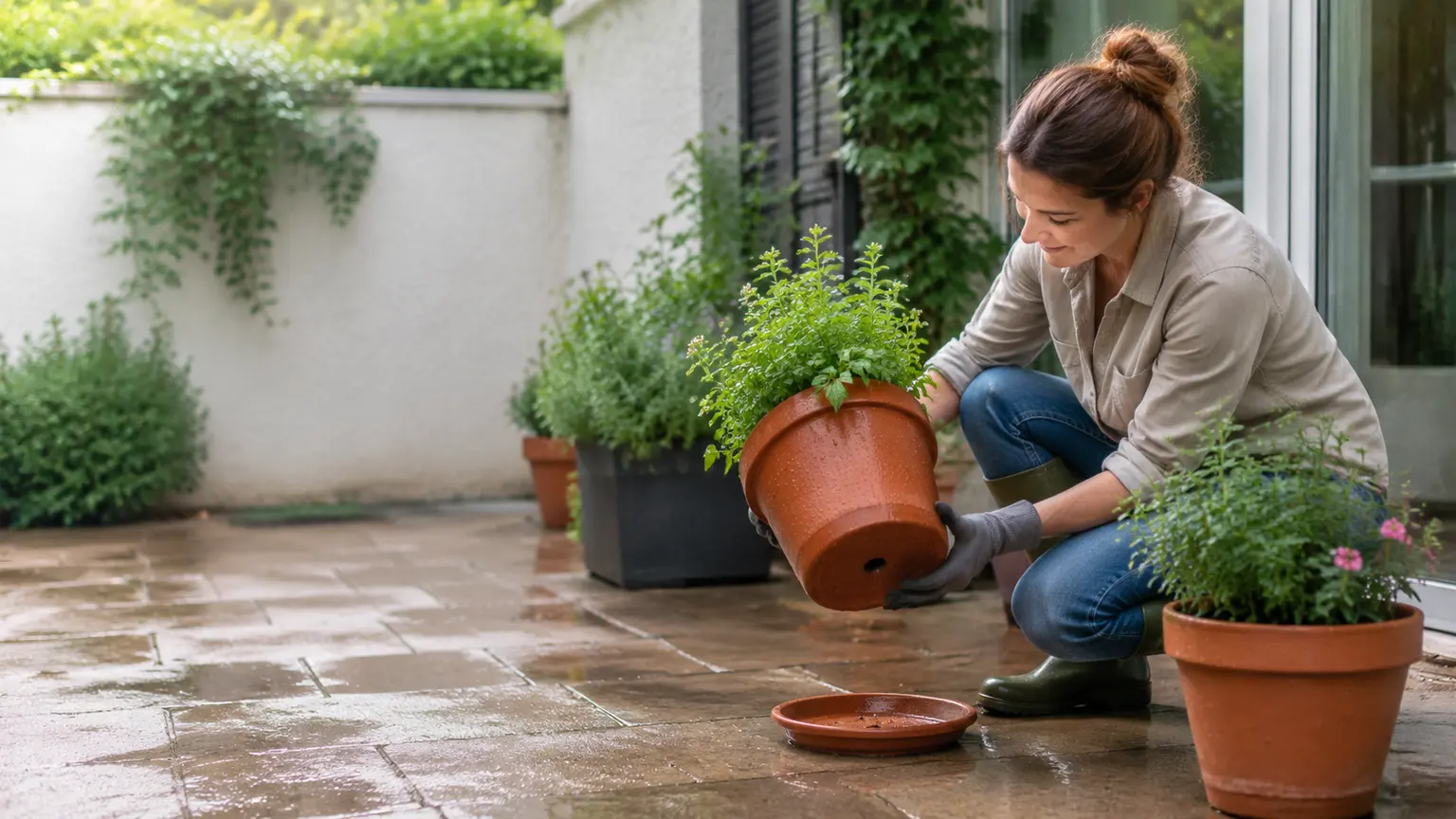
Finally, check whether the container has functional drainage. Look for blocked or covered drainage holes and consider whether water exits after irrigation. A pot that remains persistently soggy is not asking for another surface layer. Excess water limits the air available in the pore spaces, while compacted or decomposed media can lose the drainage and aeration properties needed by container roots. A coarse layer of gravel at the bottom is not a reliable solution; it can raise the zone that remains saturated.
A gentle top-dressing method for an established patio pot
Choose a calm, practical moment when you can see the surface clearly. Avoid turning a minor maintenance task into a major disturbance of an established root ball.
- Inspect the surface. Remove loose debris and identify low areas, exposed roots, the crown, and the bases of stems. Do not scrape aggressively around shallow roots.
- Select fresh medium intended for containers. Its texture should be reasonably compatible with the existing planting and should not be a dense, fine material or straight garden soil.
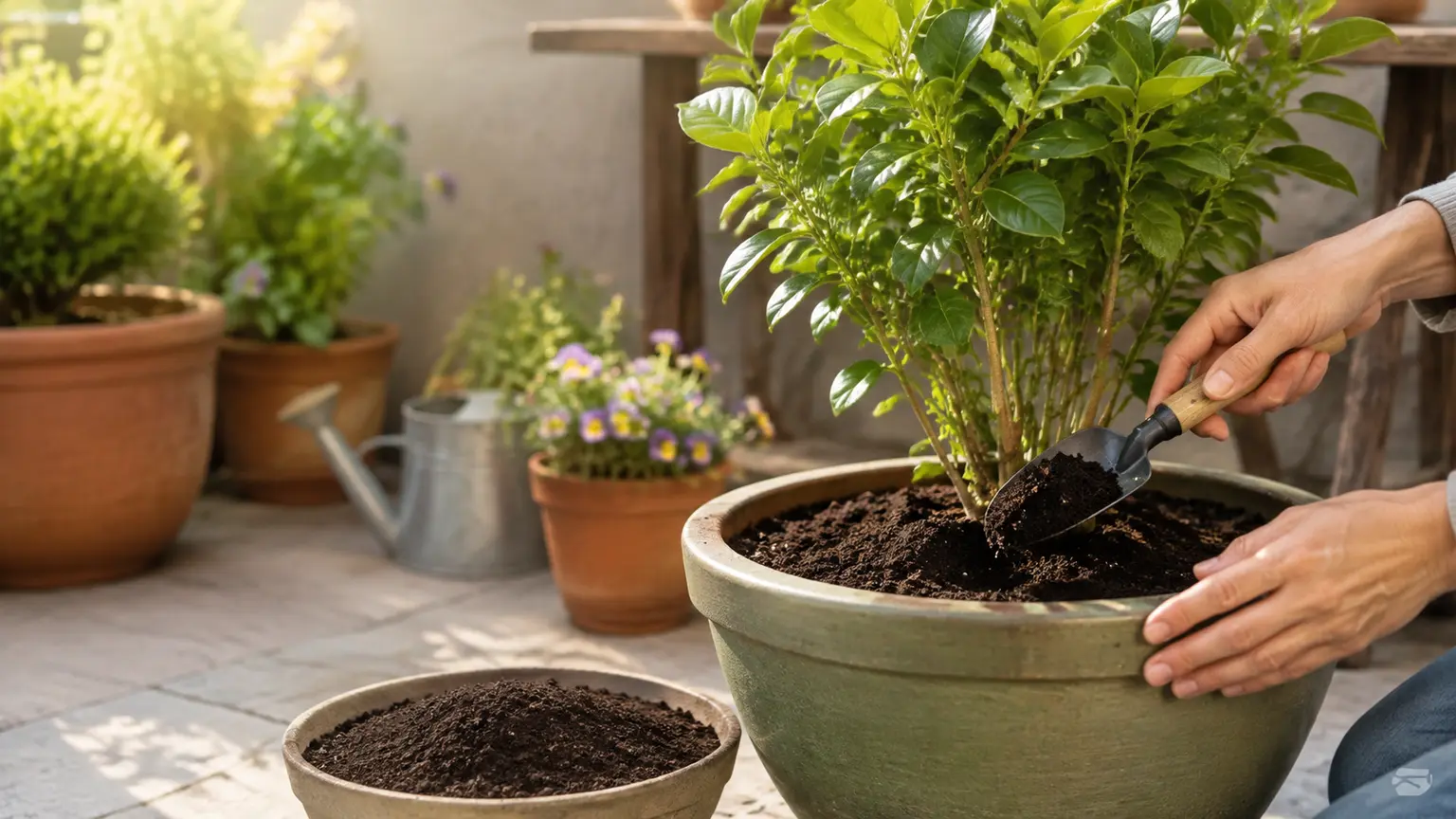
- Add only where needed. Place the fresh medium into settled or eroded areas, working around roots rather than forcing it beneath or over the crown.
- Keep the planting line intact. Stop before new mix reaches the crown, growing point, or stem base. If you cannot tell where that line belongs, pause and check plant-specific guidance.
- Level lightly. Smooth the surface with a hand or small tool, but do not press, pack, or tamp the mix around stems. Air spaces are part of what makes container medium useful.
- Preserve watering headspace. Step back and check the gap between the refreshed surface and the rim from several angles.
- Water normally. Let ordinary irrigation settle the new medium rather than compacting it by hand. Observe whether water soaks in and exits through the container’s drainage system.
After watering, the surface may settle slightly again. Recheck the crown and rim space rather than repeatedly adding mix after every small change. A modest, targeted refresh is preferable to building a new layer over the entire root zone.
Choose a medium made for containers, not a heavy shortcut
Container roots depend on a growing medium that balances support, water, air, and space for root growth. Fresh material labeled for container use is generally a more appropriate choice than soil dug from the yard. Garden soil and dense, fine-textured materials can restrict air and water movement in a confined pot.
No two packaged products perform exactly alike, so avoid assuming that every product called potting soil has the same water-holding or drainage behavior. When possible, choose a fresh medium with a texture and moisture behavior that will not be an abrupt mismatch for the established planting. A mix that stays much wetter or dries much faster than the existing root zone may change how the container dries and therefore require closer observation.
Top-dressing is not a fertilizer recipe and should not be presented as a guaranteed way to restore nutrients. It also should not be treated as a disease remedy or reverse damaged roots. Its role is narrower: restore a settled surface while maintaining the container’s planting line and drainage conditions.
When to stop top-dressing and investigate further
A surface refresh is most appropriate when the problem is visibly limited to the surface. Stop and assess the whole container when observations suggest that the root zone or container setup is involved.
- The potting mix remains wet for an unusually long time, or water does not move through the pot as expected.
- The surface is badly compacted, the medium has broken down, or the container repeatedly shows poor aeration or drainage.
- Drainage holes are blocked, covered, or otherwise not allowing the container to drain effectively, or positioned so the container cannot empty effectively.
- Roots are emerging from drainage holes, the plant dries unusually fast, or growth has slowed. These signs call for assessment rather than a diagnosis based on foliage alone.
- Inspection shows roots circling the root ball or a very dense mass in the lower part of the container. A fuller repotting assessment may be appropriate.
- Adding enough mix to cover the low area would bury the crown, stem base, or another plant structure that should remain exposed.
- The plant has specialized planting-depth needs that are unclear.
For a large or fragile patio planting, root inspection may be disruptive. Begin with the least invasive observations: drainage-hole condition, how quickly the container dries, whether water exits, and whether the surface or lower root zone seems compacted. If those checks point to a deeper problem, seek guidance from a local extension service or plan a careful repotting assessment suited to the plant and container.
A small repair with clear limits
Refreshing the top layer works best as a precise correction for a settled or eroded surface. Use fresh, container-appropriate medium, protect the existing crown-to-media line, avoid compaction, and leave room below the rim for irrigation. If the container’s drainage, aeration, or root space is failing, adding more material on top will not correct the underlying problem and may reduce headspace or bury the crown. In that case, the useful next step is assessment of the pot and root zone—not a deeper layer of top-dressing.
Sources and further reading
- site.extension.uga.edu — site.extension.uga.edu
- extension.psu.edu — extension.psu.edu
- extension.psu.edu — extension.psu.edu
- content.ces.ncsu.edu — content.ces.ncsu.edu
- ucanr.edu — ucanr.edu
- extension.umd.edu — extension.umd.edu
- extension.illinois.edu — extension.illinois.edu
- ucanr.edu — ucanr.edu
- njaes.rutgers.edu — njaes.rutgers.edu
- fieldreport.caes.uga.edu — fieldreport.caes.uga.edu