Extreme heat can make a container plant look thirsty even when its potting mix is moist. Before adding shade or water, take a few minutes to identify what is happening. Then start with the least complicated change: move the pot away from the harshest exposure. If a temporary cover is needed, place it above the foliage—not directly on it—and treat umbrellas or freestanding shade as conditional equipment rather than a permanent fixture.
Start with a five-minute heat-stress check
Look at the plant during the hottest part of the day, then check it again after the sun drops and conditions begin to moderate. Temporary midday wilt can occur when leaves lose water faster than roots can take it up. If the plant recovers later, heat and exposure may be contributing to the problem.
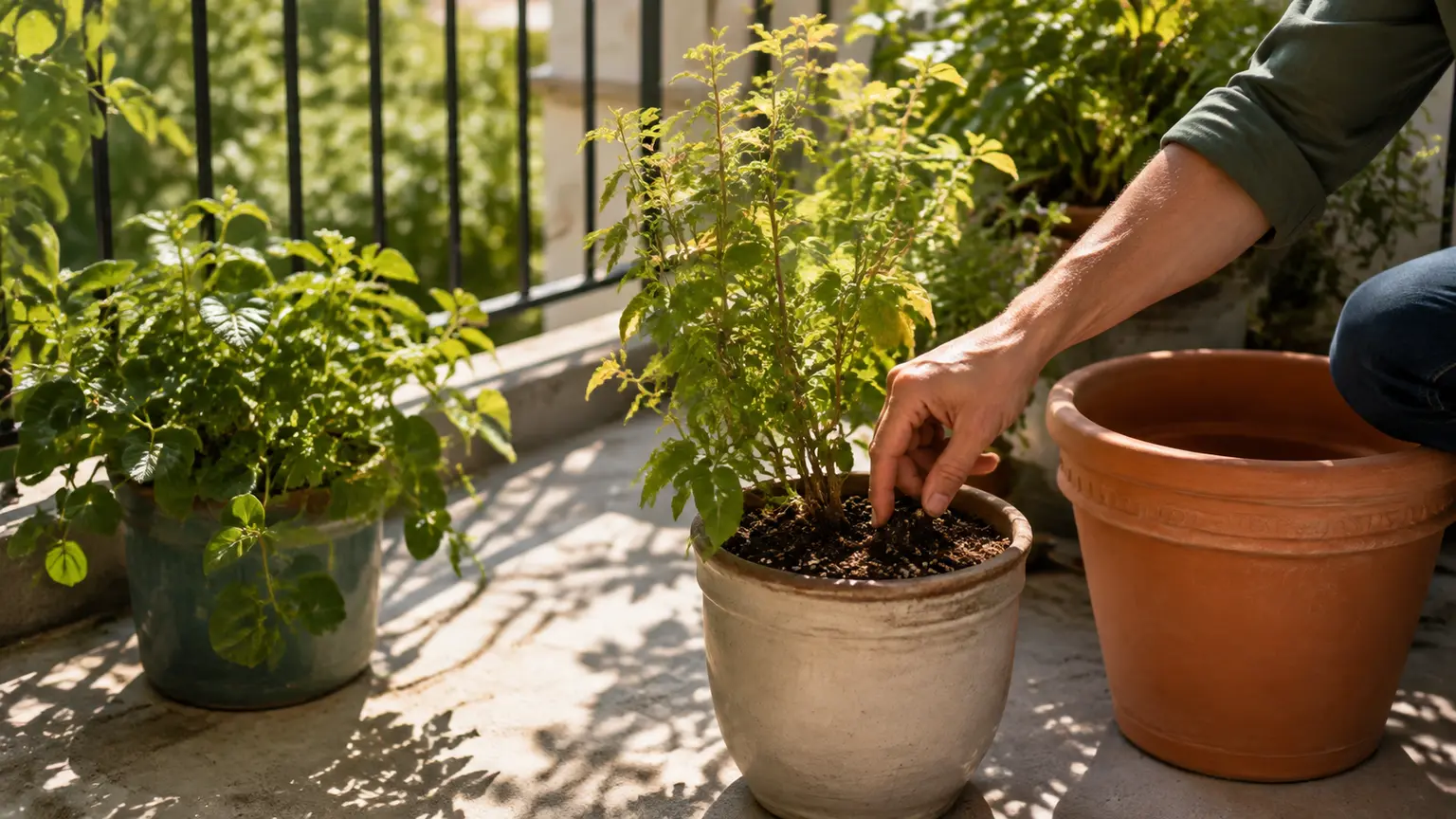
Leaf droop alone is not a watering instruction. Feel or inspect the potting mix according to the container and plant’s needs. A dry mix calls for thorough watering that moistens the root ball and allows excess water to drain. A wet mix paired with wilting can indicate a different problem: prolonged waterlogging can deprive roots of oxygen and also cause wilt.
- Check the potting mix rather than relying only on leaf appearance.
- Look for persistent wilt, scorched or damaged foliage, and changes that remain after the hottest period passes.
- Notice the setting: afternoon sun, reflected heat from pavement or walls, a dark container, and hot or drying wind can all add stress.
- If decline continues, consider that pests, disease, root problems, fertilizer-salt injury, or waterlogging may be involved. Local Extension offices can help with diagnosis.
Container plants may need more frequent moisture checks in hot, dry, or windy weather, but there is no dependable schedule for every pot. Container size and material, plant type, weather, and placement all affect how quickly the mix dries. Avoid turning a heat response into chronic overwatering.
When is moving a patio plant better than shade cloth?
For manageable containers, relocation is usually the most renter-friendly response. Shift a pot away from the hottest afternoon exposure or from a wall, pavement, or other surface that reflects or stores heat. The guide to reducing reflected heat without renovating provides a fuller site check. A brighter spot with gentler light may be more useful than deep shade, especially for a sun-loving ornamental or a fruiting crop.
Think of the move as temporary stress management, not a new permanent light plan. Match the new location to the plant’s stated light needs and its recent exposure. A plant accustomed to strong sun may not perform well indefinitely in deep shade, and moving every plant into the same low-light location can create a different problem.
Move only what can be handled safely. Use a cart designed for the purpose if appropriate, and keep the route clear while moving pots. On exposed patios, balconies, or rooftops, wind can topple containers and damage foliage; relocating a plant to a less exposed position may be safer than trying to shield it with a large, unsecured object.
Can shade cloth protect balcony plants from heat stress?
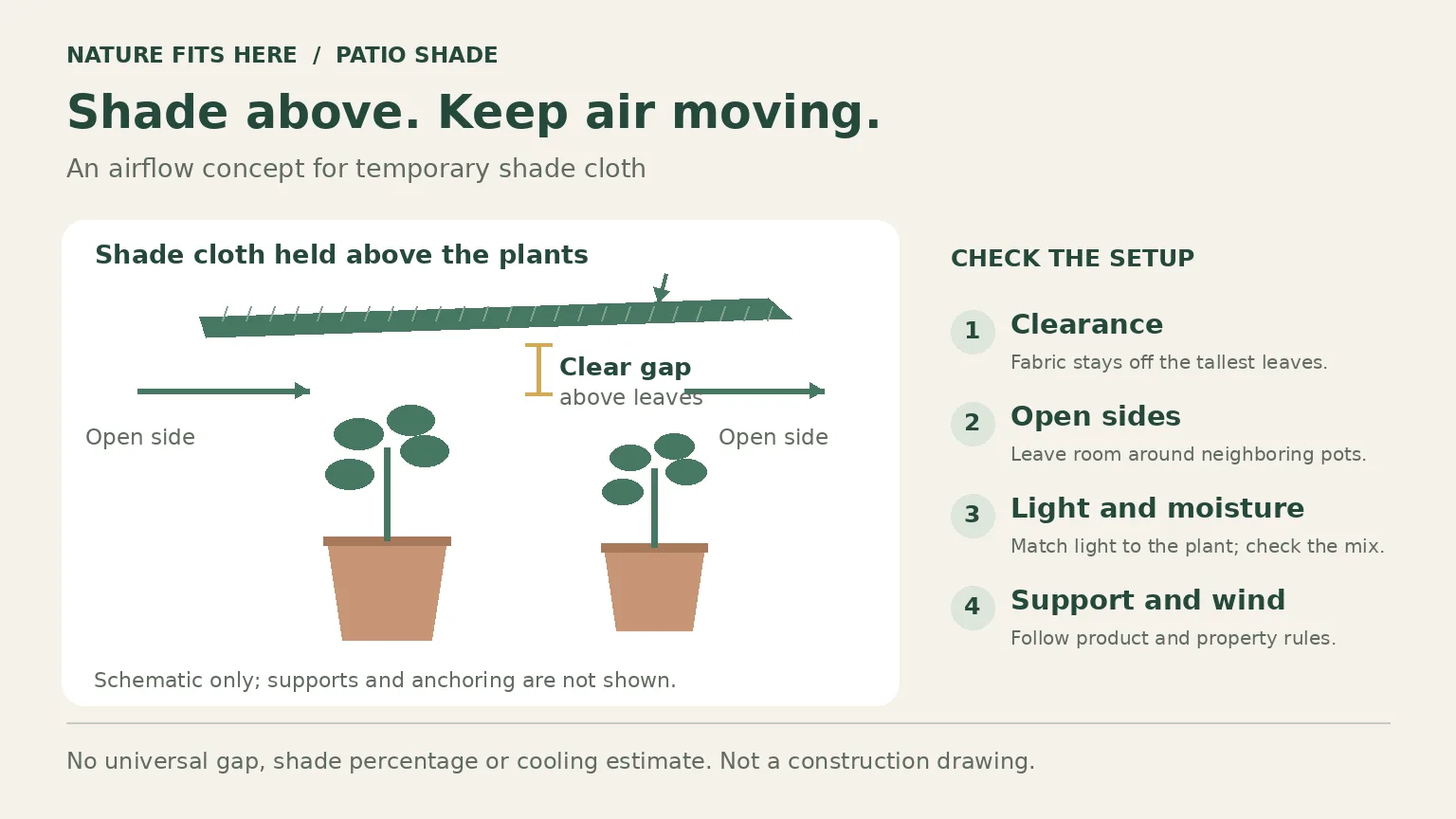
When moving the pot is not enough, temporary shade cloth can provide overhead relief during an extreme-heat period. The important setup detail is an air gap: hold the cloth above the plant on a movable frame so it does not rest on leaves or wrap tightly around the container. Shade from above while leaving space around the foliage for air movement.
Choose the amount of shade based on the plant’s light requirements, its recent sun exposure, your patio’s intensity and orientation, and the purpose of the cover. Protecting a newly exposed plant, reducing harsh afternoon exposure, and shading a plant that normally grows in bright light are not identical situations. Regional Extension examples include different shade levels for particular plants and conditions; they should not be treated as a universal percentage for every U.S. patio.
What shade cloth density is appropriate?
The percentage on shade cloth describes how much incoming light it blocks; a higher percentage creates deeper shade. There is no single correct density for every balcony plant. Start with plant- or crop-specific guidance from your local Extension service and the cloth manufacturer, then account for orientation, reflected heat, season, and how long the cover will be used. Do not assume that a higher percentage is automatically safer: too much shade can reduce the light a sun-loving plant still needs.
| Situation | Safer first choice | Reassess when |
|---|---|---|
| One movable pot takes harsh afternoon sun | Relocate it for the hottest hours | The new position is too dark or still overheats |
| Several pots share the same brief exposure | Temporary overhead cloth with open sides | Wind rises, fabric sags, or light becomes inadequate |
| Reflected heat is strongest near a wall or paving | Increase distance from the hot surface | The plant still shows persistent stress after conditions moderate |
| A permanent attachment would be required | Ask the property manager and use no installation until approved | Written permission and product requirements are clear |
How do you keep shade cloth from blocking airflow?
- Hold the cloth above the tallest leaves so it cannot rest on the canopy.
- Shade mainly from above or from the harsh-sun side instead of wrapping the plant.
- Leave the sides open and preserve a clear path for air around neighboring pots.
- Remove or adjust the cover if it sags, touches foliage, blocks access, or makes the setup unstable.
- Keep drainage checks in the routine; shade changes drying rate but does not correct waterlogged mix.
Use temporary shade for the period of extreme conditions, then reassess. As heat moderates, reduce or remove the cover when the plant’s normal light needs call for it. Avoid making several disruptive changes at once: during extreme heat, transplanting, heavy pruning, and routine fertilizing are generally avoidable stresses. Shade and careful moisture management are lower-disruption first steps, but they will not correct every underlying problem.
Three patio setups: choose a response, then check it
These are illustrative planning scenarios, not field trials or reports of measured cooling. The named plants describe the example setting; use the label and local guidance for your own species or cultivar. Apply the earlier moisture check before changing exposure.
One movable basil pot: try a different position first
Example setting: A basil container on an east-facing patio receives morning sun, then a short spell of direct sun later in the day as building shadows move.
Mark where the pot actually receives that later sun. If the mix is suitably moist but afternoon droop persists, try an existing position with gentler afternoon exposure while retaining light appropriate to the plant. Move only a safely manageable pot; no frame is needed when the existing shade solves the placement problem. Check the mix and foliage again after the exposure eases and the following morning. Continuing decline calls for diagnosis rather than repeated moves.
Several tomato pots beside a west-facing wall: separate wall heat from direct sun
Example setting: A group of tomato containers receives late-afternoon sun beside a wall that remains warm after its surface enters shade.
Start by increasing distance from the wall where space allows. If direct sun still reaches the leaves during the difficult period and relocation is impractical, consider a permitted temporary overhead cover using the product's specified support. Keep the sides open and retain the light the crop needs outside that period. Inspect each pot separately: a shaded container may remain moist while its neighbor dries. An overhead cover does not eliminate heat stored in the wall or paving; use the reflected-heat guide if that exposure remains the problem.
A geranium on a windy balcony: relocation can be the better shade plan
Example setting: A potted geranium on a south- or west-facing balcony is exposed to afternoon sun and intermittent gusts.
Identify an existing sheltered position that still provides suitable light and keeps access clear. A large fabric cover adds a wind-sensitive object, so use relocation when a permitted product cannot be secured within its instructions and wind limits. Do not use the railing as an improvised anchor. If a cover is appropriate, inspect clearance above the tallest leaves and neighboring pots as conditions change. Remove it when fabric touches foliage, the support shifts, or wind exceeds the product's limits. There is no universal safe wind speed for every shade system.
Read the airflow diagram before choosing a frame
The illustration above shows the principle: shade cloth above the canopy, a visible gap to the tallest leaves, and open sides. It is a schematic, not a construction drawing, and supplies no universal gap dimension, anchor design, shade percentage, or cooling estimate. Choose clearance that remains open as the plant grows and the fabric moves, using the product's instructions. If that clearance cannot be maintained, reposition the pot or use another permitted shade option.
Keep a short before-and-after observation log
| Record | Before the change | At the next check |
|---|---|---|
| Site and plant | Plant or cultivar, orientation, sun period, wall and wind exposure | Note which conditions changed |
| Root zone | Below-surface moisture; drainage and saucer condition | Check again before adding water |
| Foliage | Time of droop and any persistent damage | Observe after exposure eases and the following morning |
| Shade setup | Existing shade or temporary cover; support and clearance | Check light, sagging, airflow, access and wind |
Change one manageable exposure factor at a time and record the weather; a cooler following day is not evidence that the cover alone caused improvement. Use the patio sun, heat and wind map for placement, the hot-weather watering guide when mix is dry, or the free drainage checklist when water is trapped. Temporary shade remains a response to observed exposure, not a replacement for moisture checks.
Protect the pot and roots without overcorrecting
Sometimes the container is taking more heat than the foliage. Dark pots, paved surfaces, reflected heat, and hot wind can compound stress around the root zone. Moving the pot to a less exposed surface or shading the container itself may help preserve an appropriate light level for the plant above it. Do not promise a specific temperature reduction: results vary with pot material and color, sun angle, wind, plant size, surface type, and watering.
Continue checking the mix as conditions change. When watering is needed, moisten the root ball thoroughly and let excess drain. Do not leave the container sitting in prolonged standing water. Check more often during hot, dry weather, but let the actual condition of the mix—not a fixed calendar or a wilted leaf alone—guide the decision.
How can renters support shade cloth safely?
A freestanding umbrella or shade structure can be useful only when the product and location make it appropriate. Follow the manufacturer’s setup, ballast, and wind instructions exactly. Stop using it when conditions exceed the product’s stated limits or when wind makes the structure or nearby containers unstable. Do not improvise anchors, counterweights, railing attachments, or load-bearing solutions.
For renters and condo residents, temporary does not automatically mean permitted. Before setting up shade, check the lease, condominium or HOA rules, and any instructions from the landlord or property manager. Do not attach a shade system to a railing, exterior wall, balcony, or other building element without written permission and any required approval.
Keep pots, carts, umbrellas, frames, and cloth out of doors, stairs, pathways, and other exit or access routes. Federal fire-service training material emphasizes maintaining exits and access to them free of obstructions, but the enforceable requirements for a particular property depend on local rules and the building. When in doubt, ask the property manager before placing anything where people may need to pass quickly.
A simple heat-wave routine
- Check the potting mix and observe whether midday wilt improves after the sun drops.
- Move manageable pots away from the harshest afternoon exposure, reflected heat, or drying wind while retaining suitable light.
- If needed, install temporary overhead shade with clear space around the foliage for airflow.
- Inspect moisture more frequently in hot, dry, or windy conditions, then water thoroughly with room for drainage when the mix requires it.
- Remove or reduce temporary shade when extreme conditions pass, according to the plant’s light needs.
- Review wind, lease, condo or HOA, local safety, and exit-clearance requirements before using an umbrella or frame.
The goal is not to make every patio plant equally shaded. It is to reduce the most stressful exposure for a limited period while preserving airflow, appropriate light, drainage, and safe access. If a plant remains wilted or continues to decline after conditions moderate, use the water, shade, or pot-size diagnostic and the heat-wave response plan instead of automatically adding more shade or water.
Quick-reference graphics
Save these visual reminders and use the full guidance above for context.
Sources and further reading
- extension.oregonstate.edu — extension.oregonstate.edu
- extension.arizona.edu — extension.arizona.edu
- extension.umn.edu — extension.umn.edu
- extension.arizona.edu — extension.arizona.edu
- extension.illinois.edu — extension.illinois.edu
- extension.illinois.edu — extension.illinois.edu
- extension.illinois.edu — extension.illinois.edu
- extension.illinois.edu — extension.illinois.edu
- apps.usfa.fema.gov — apps.usfa.fema.gov